Friday, 18 May 2007

Week 10 - AA1 - Drums

Drums are the instruments I enjoy recording the most. This will be the sixth time I've recorded a drumkit and it's still exciting. This drum recording is taken from my main AA1 recording project that was done on Saturday. It’s a standard drum kit. Kick, snare, r1, r2, floor, hihat, ride and a cymbal. The session plan for the project was used but I did add the KM84’s for ride and hihat. After Bradley helped set the mics up in their approximate location, I set about getting more fussier as I started to pull a sound. First up I wanted to set the overheads. As I listened in the control room with headphones, Bradley moved the U87 up and down and across the floor tom for me as I listened for optimum resonance. The second overhead was placed by my listening again in headphones to get the snare in the middle of the stereo field. I chose the U87's because they seem more rounder and less bright/splashier on the cymbals than smaller diaphragm condensers I've used in the past.
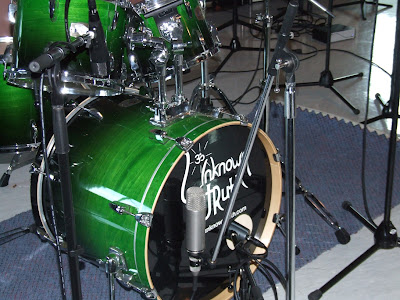
I had the NTV on the kick originally, but then changed to the U89i simply because I thought it sounded better. I didn’t want a “clicky” sound at all and was going for more of a “thump.” I did have the e602 on the inside of the kick though, but that was to get more of a cleaner, tighter sound to blend with the outside mic.
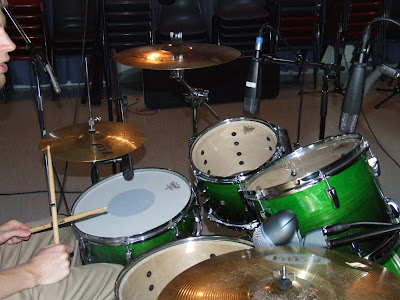
The snare had the MZ-204. This was ok, but I perhaps should have changed the mic as there is a slight ring and it sounds a little boxy and thin.

The MD421’s are fantastic. This is the first time I’ve had the opportunity to use them on toms. Out of necessity, I used the Beta 52 on the floor tom. It just fit between the ride and rack 2.I used AKG 414’s set to omni for room mics. They were down low to the ground about ten feet away pointing at the kick. I set myself a challenge of not using eq during recording or mixing, so this is the raw sound as is.
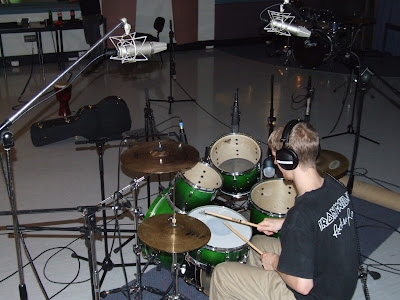
Drum recording 1: This is the full kit, all mics.
Drum recording 2: This is a minimal sound with more ambience. Only the snare, inside kick mic, the overheads and the room mics were used.
-
Fieldhouse, Steve. 2007. “Audio Arts 1 Seminar – Drums.” Seminar presented at the University of Adelaide, 15th May.

Saturday, 12 May 2007

Week 9 – Forum – Tristan Louth-Robins - Singing Teapot

I must admit, I was expecting the teapot to sing similar to when a crystal glass sings when you run your finger around the rim. When I thought of resonating teapots, I had visions of having the teapot being vibrated by an outside frequency by sympathetic resonance (perhaps even by a sub or ultra frequency) and therefore giving off it’s own audible frequency. I was slightly disappointed because I was excited by my expectations, but it was interesting nonetheless.

I’d like to offer my opinion on the subject in case a few simpler ideas were overlooked. In a large room as Alvin Lucier experimented in it wouldn’t have been as big an issue, but forcing the sound back into the teapot (and probably most likely by the appearance of new overtones seen in later screengrabs of Peak) may be creating a pressure mode. A 200Hz wave is around 172cm which the teapot clearly isn’t but playing these frequencies into an area that can't reproduce them properly (and I know the argument will be that the teapot generated this frequency itself, but that frequency was originally recorded outside of the teapot in a room capable of reproducing 200Hz)will cause a buildup of frequencies below that point. They will then start to generate their own harmonics interfering with any sort of 'flat response' there might have been. There could also have been a standing wave present. A sphere is of course the perfect place for standing waves to thrive. Even though the teapot is not a perfect sphere, the widest part horizontally is perfectly round as far as I could tell apart from the area with the spout. Every opposite is exactly the same length on this axis and any resonant frequency would be reinforcing itself. 344/400 (double the length of the suspected standing wave) is 86cm. It just so happens that 5 instances of 17.2 = 86. This alone as far as I'm aware won't create a standing wave as the waveforms have to move past each other, and all this may be stretching things but it would be interesting to see if the inside of the teapot’s measurement was in fact 17.2cm. This would hide the actual resonance of the teapot structure and focus our ears on the resonance of the first standing wave of the teapot.

Noting the volume and keeping future passes through the teapot at that particular volume level would create a constance that would eliminate amplifying the standing wave and avoiding a pressure mode altogether allowing the true resonance of the teapot to sing. Come to think of it that may work nicely. If the original recording from the teapot was at say 20dB (or whatever), then play it back into the teapot at –3dB from that level. That way the original resonance is added to perfectly. The progress could be checked at intervals by amplifying the results so they could be heard at a decent level, but at least it should be free of artifacts and be a true resonance of the teapot. There’s also the addition of presence peaks from the mic and the amplifiers THD figures that need considering. Perhaps experiment with different mics, speakers, preamps and amplifiers as the fact that the tone landed exactly on 200 Hz seems odd to me. It’s not 197.3 or 204.7 for example but smack bang on 200Hz. Eliminating rogue frequencies would give a more acurate result. All this is from a slightly scientific point of view and if the whole aim is to simply make an instrument out of it then I’d say it works nicely as is.

Whittington, Stephen. 2007. Forum Workshop “Still and Moving Lines”. Forum presented at the University of Adelaide, 10th May.

Louth-Robins, Tristan. 2007. Forum Workshop “Still and Moving Lines”. Forum presented at the University of Adelaide, 10th May.


Week 9 – CC1 – Desktop Music Environment(3)

This time around I made a couple of loops that I could trigger in reason instead of random noises. I thought I’d have a go at making a rhythmic ‘song.’ Well, a song of sorts.

There’s a really long drone that was made from the word “thereafter”, well bits of it since Tab to transient cuts off a little at the start. This is a really cool sound. It’s almost like the sound from the aliens in War of the Worlds. It was made from simply time stretching the word to around 7 seconds. I then normalised it to 95% and went to add reverb. It’s a mono track and I felt it didn’t have enough space to it so doubled the track and applied some chorus to one. I put both on a stereo track and then applied the reverb via an Audiosuite plugin.

I did the gate trick whereby ‘triggering’ a sound by using the Key Input on the gate. The gate was placed across a long droning sound that was phasing. A small transient from another sample was used as the trigger.


There were seven sounds in all when I finished bouncing the parts in Pro Tools. These were imported into Reason and placed in the key zones that were within easy reach on the keyboard. The main rhythm sounds all had a C as their trigger key (but I did have a whole octave for each rhythm sound) to keep them in tune, but I did try hitting other keys within that octave to try different combinations and syncopations. Some worked, some didn’t. Although it’s not entirely in time properly, I am happy with the progress I am making.
-
Finished Soundscape. (Databus won't let me upload for some reason. The file is on this page at the bottom labelled Reason2.)
-
Haines, Christian. 2007. “Creative Computing.” Seminar presented at the University of Adelaide, 10th May.

Digidesign. 1996-2007 Avid Technology, Inc All Rights Reserved.


Reason. 2007 Propellerhead Software, Inc All Rights Reserved.

Week 9 – AA1 – Bass Guitar Recording


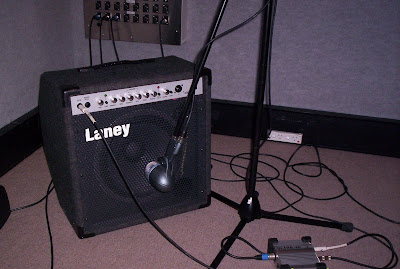
All of these recordings have had compression and eq applied.


Bass1
This was recorded with a 414 about a metre away. Although there's a bit of fret buzz, it has nice transients and is a solid sound. I'd use this sort of sound on 'new metal' or a recording for funk band as I'd imagine it would sound quite good if it was a slap style of playing.


Bass2
I moved the mic a bit closer this time. It sounds cleaner in the higher frequencies while remaining solid in the lower frequencies. It seems a little rounder to my ears, more fuller. I do like this sound better than the first, but it could really only be judged by putting it in a mix.


Bass3
This was miced with the SM56 aimed at the centre of the speaker. This doesn't seem to have the same top end edge as the first two and seems a little thinner sounding.


Bass4
This is the Behringer DI recording. This is the most 'thinnest' sounding. I wouldn't use this alone in a mix. It would be blended with an amp sound.

Bass5
This is the Sm56 and the DI signal combined. They were time aligned. The difference is noticable as the two separate waveforms have different timbral qualities, but when added together combined well and add a new depth and power to the sound. Kind of reminds me of the Faith No More bass sound.


Bass6
This is the 414 and DI signal combined. For this example I decided to automate the phase button on an EQ (which was left flat) to demonstrate the difference phase has on the power of a sound. Although the signal became out of phase, the bottom end was deeper and more powerfull. It definitely sounds better out of phase.
-
Fieldhouse, Steve. 2007. “Audio Arts 1 Seminar – Bass Guitar.” Seminar presented at the University of Adelaide, 8th May.

Digidesign. 1996-2007 Avid Technology, Inc All Rights Reserved.

Sunday, 6 May 2007

Week 8 - Forum - Gender and Music Technology (2)

It was refreshing to see that this week everyone steered clear of the usual stereotypes and concentrated on the music. The dehumanised sound of the band Kraftwerk was, in Bradley’s words “de-gendered.” I tend to agree as it had odd quirky lyrics that were sung with odd effects taking the male/female sound out of it. Speaking of perspectives from a gender point of view, the issue of cyborgism was raised. I find this topic fascinating as there are so many programs coming out that can make music from very little input from the operator. Just scan a photo or type in some letters and the program does the rest. Talk about completely removing gender! Yes, these ‘songs’ are usually of a low standard compared to a human composer, but nevertheless it’s a step forward. Computers such as ENIAC could barely add two and two together a few decades ago. Which brings me to the Matrix. Who would have thought I would have gotten such visual images popping in my head of ‘penetration’ at a forum. I’ve never thought of the Matrix like that, and whether I agree or disagree, it did force me think further outside the square which is always a good thing. I wonder how Trinity fits into it all. Maybe I'll leave that one alone.

For intermission we were treated to a viewing of the Bohemian Rhapsody Show and then it was back to the forum.

There is sometimes cultural stereotyping that should be considered as Edward pointed out. I remember when I was at high school and the teachers would be sorting out the work experience week. Students would be stuck in jobs that the teachers thought they would be best suited for. Shouldn’t the student choose? This was a long time ago so I hope they sort it out differently these days. Although, it is probably done on a computer which no doubt brings some scary results.

Whether we see a penis when we look at a microphone advertisement or not is always going to be subjected to opinion. The same applies to whether a woman (or a man for that matter) can do a particular job or is even accepted by their peers. Unfortunately opinion in a persons ability is usually the deciding factor. Not their actual ability.

Whittington, Stephen. 2007. Forum Workshop “Can You Tell the Difference? - Gender in Music technology”. Forum presented at the University of Adelaide, 3rd May.

Harris, David. 2007. Forum Workshop “Can You Tell the Difference? - Gender in Music technology”. Forum presented at the University of Adelaide, 3rd May.

Leffler, Bradley. 2007. Forum Workshop “Can You Tell the Difference? - Gender in Music technology”. Forum presented at the University of Adelaide, 3rd May.

Gadd, Laura. 2007. Forum Workshop “Can You Tell the Difference? - Gender in Music technology”. Forum presented at the University of Adelaide, 3rd May.

Cakebread, Ben. 2007. Forum Workshop “Can You Tell the Difference? - Gender in Music technology”. Forum presented at the University of Adelaide, 3rd May.

Kelly, Edward. Forum Workshop “Can You Tell the Difference? - Gender in Music technology”. Forum presented at the University of Adelaide, 3rd May.

Week 8 - AA1 - Electric Guitar

Guitar1: Sennheiser 421 off axis pointing towards edge of cones dust cover, 5cm away from edge and 5 cm away from front.

Guitar2: Neumann U87 off axis pointing towards edge of dust cover, 5cm away from edge and 6cm away from front. This had a few various positions as on axis, further away, etc but often it sounded boxy.

This is the two guitars mixed together. It's pretty ordinary. I haven't picked up a guitar in about a year and it shows.

Guitar3: This is (yes the same two mics) set up in XY about 10cm away from directly in front dead centre.

I was going to add the next part of the Metallica song but got utterly frustrated with the sound. Perhaps I should have recorded the crappy solid state noise to make up the numbers for this assignment, but to be honest all I got was a headache from going back and forth to the dead room moving the mic and fiddling with amp settings. Even if I did record the sound, it was completely different than what was coming out of the amp. I recorded with no eq or compression and the amp had it's treble and mids rolled completely out, but what was coming through the monitors was a brittle, bright, edgy and distorted 'cheap' sound. I had plans of recording a man's amp over the weekend, but unfortunately I didn't get a quiet moment alone at home to set mine up.
-
Fieldhouse, Steve. 2007. “Audio Arts 1 Seminar – Electric Guitar.” Seminar presented at the University of Adelaide, 1 May.

Week 8 - CC1 - Desktop Music Environment (2)

Well after last weeks debacle working with Reason, I figured I’d better sort this ‘key zone’ issue out properly. Yay! It seems I have sorted it out, but before we get into that there’s some sound manipulation in order on Fscape and SoundHack. I used the band splitting plugin in to split the word Behold into 8 parts and processed the full sentence in SoundHack with the phaser vocoder plugin, then split that into 4 parts with the band splitter. I went back to play around with it some more today, and chose some extreme settings. I think they were a little too extreme as the file size went balistic. I found it strange that there is no cancel option to stop a process, but since it is an early audio processor it is easy to forgive. I let it get to over a Gig before I quit the whole program down to stop it.

As I mentioned earlier I have figured out the key zones and placed my sounds together where they would be convenient to play and give the right pitches I was after. I’m still no keyboard player but I am much happier with the results this week and am getting more confident with Reason. After todays Perspectives lesson, I think it would be a good task for me to figure out how to assign different sounds to velocity changes.


Finished Soundscape.

Haines, Christian. 2007. “Creative Computing.” Seminar presented at the University of Adelaide, 2nd May.

Reason. 2007 Propellerhead Software, Inc All Rights Reserved.